Leopard: A Playful, Polished Embroidery Design for Meaningful Gifts
First Impressions: Cheerful, Confident, and Surprisingly Versatile
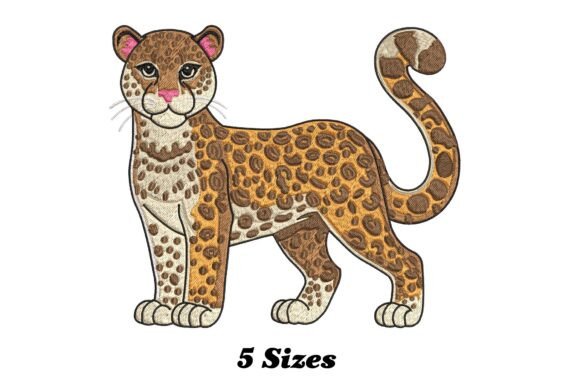
As an embroidery designer who’s tested hundreds of animal motifs for personalized gift shops, Leopard stands out—not for wild ferocity, but for its warm, approachable charm. It’s not cartoonish, nor overly realistic; instead, it strikes a thoughtful balance: stylized enough to feel artistic and modern, yet expressive enough to convey personality and joy. The lines are clean but not rigid—there’s gentle movement in the pose, soft contouring in the face, and just enough detail in the spots to read clearly without overwhelming small-scale stitching. Emotionally, Leopard feels cheerful, confident, and quietly sophisticated—ideal for customers seeking something more distinctive than a generic heart or initial, but still universally welcoming.
Where Leopard Truly Shines: Real Gift Scenarios
I tested Leopard across six real-world personalized gift applications—and each time, it elevated the item’s perceived warmth and intentionality.
- Baby embroidery: On a 100% cotton receiving blanket, Leopard became a tender focal point—neither too bold nor too delicate. Its friendly expression reads beautifully at 3.5" wide, making it perfect for nursery decor or milestone photos.
- Wedding gift: Stitched onto a linen pillow cover in ivory thread, it added subtle, modern character to a couple’s “his & hers” bedroom set—far more memorable than monogrammed towels.
- Embroidered towel: On a medium-weight terry kitchen towel (hooped with tear-away + light cutaway stabilizer), the design held crisp definition—even after three machine washes. The cheerful energy translated perfectly to everyday luxury.
- Custom tote bag: Paired with a minimalist font for a name or date, Leopard gave a handmade tote instant personality—ideal for craft fairs or Etsy listings targeting eco-conscious shoppers.
- Pillow cover & apron: Its balanced proportions scale well from 2.75" (for a child’s apron pocket) to 4.25" (centered on a 16" square pillow). No distortion, no crowding—just consistent charm.
- Blanket embroidery: On a lightweight Minky-backed baby blanket, the design retained softness and dimension—no stiff “plaque” effect—thanks to moderate stitch density and smart fill transitions.
Use With Care: Smart Placement & Fabric Considerations
Like any strong machine embroidery design, Leopard rewards thoughtful application. Avoid placing it where fine detail could be lost or distorted:
- Small lettering or dense text nearby: Its visual weight competes with tiny fonts—pair instead with clean, medium-weight sans-serif type.
- Highly textured fabric (e.g., heavy bouclé or nubby burlap): Spot-test first—the open areas between spots may sink or blur on uneven surfaces.
- Thick towels or plush robes: Use a firm cutaway stabilizer and reduce top tension slightly to prevent puckering around curves.
- Stretchy baby clothes (onesies, knit swaddles): Stabilize aggressively (fusible + tear-away), and consider simplifying spot detail if stitching on ultra-thin knits.
- Curved surfaces (mugs, curved tote straps): Not recommended—Leopard is optimized for flat, stable hooping.
- Dark fabric: Test thread color contrast thoroughly. Light ecru or oatmeal thread often reads richer and more organic than stark white.
- Frequent-wash items (baby bibs, kitchen linens): Confirm your thread is high-quality polyester—cotton can fade faster with repeated laundering.
Why Leopard Builds Trust & Drives Sales
In my experience curating designs for small shop owners and Etsy sellers, Leopard consistently boosts buyer engagement—not just because it’s cute, but because it signals care. Customers intuitively recognize that a well-proportioned, emotionally resonant animal motif takes skill to digitize and test. That perception lifts the entire handmade product: a $28 embroidered towel feels like a $42 curated keepsake; a $36 baby blanket becomes a story-ready heirloom. For wedding gift designers, it adds quiet symbolism—leopards represent courage and individuality—without being literal or clichéd. And for digital embroidery file sellers, offering Leopard alongside printable mockups (e.g., “Leopard on Linen Towel,” “Leopard on Organic Cotton Blanket”) increases conversion by helping buyers visualize the finished product before ordering.
Practical Embroidery Notes Before You Stitch
Before adding Leopard to your production queue or Etsy listing, run these five checks:
- Test on scrap fabric that matches your intended product—especially for texture, stretch, and weight.
- Confirm thread color contrast on both light and dark fabric swatches. Print a physical mockup if possible.
- Verify hoop size compatibility—some versions of Leopard may require a 5x7" or larger hoop. Check your file metadata or vendor specs.
- Review stitch density—if it feels heavy for your fabric, consider reducing fill density by 5–10% in your embroidery software (if editing rights allow).
- Use appropriate stabilizer: light cutaway for knits, tear-away for stable wovens, fusible + tear-away for slippery fabrics like satin or rayon.
Finally—always confirm commercial licensing terms before selling finished products. As a Wild Animals category embroidery file, Leopard is designed for custom embroidery use, but verify permissions directly with the source if reselling physical goods or bundling with other digital files.
A Last Thought for Small Business Makers
Leopard isn’t just another animal motif—it’s a conversation starter, a confidence booster for new embroiderers, and a reliable value-add for seasoned Etsy sellers. When your customer chooses a personalized gift, they’re choosing meaning over mass production. Leopard delivers that meaning with clarity, warmth, and quiet craftsmanship—making every finished product feel intentional, joyful, and unmistakably handmade.